
Written by: Katherine Haugh, The Convive Collective
Strategic philanthropy and trust-based philanthropy have each helped the field ask important questions. Are we clear about the change we want to support? Are we using evidence well? Are we respecting the knowledge and agency of the people we fund? Are our own practices getting in their way?
These are questions worth holding together.
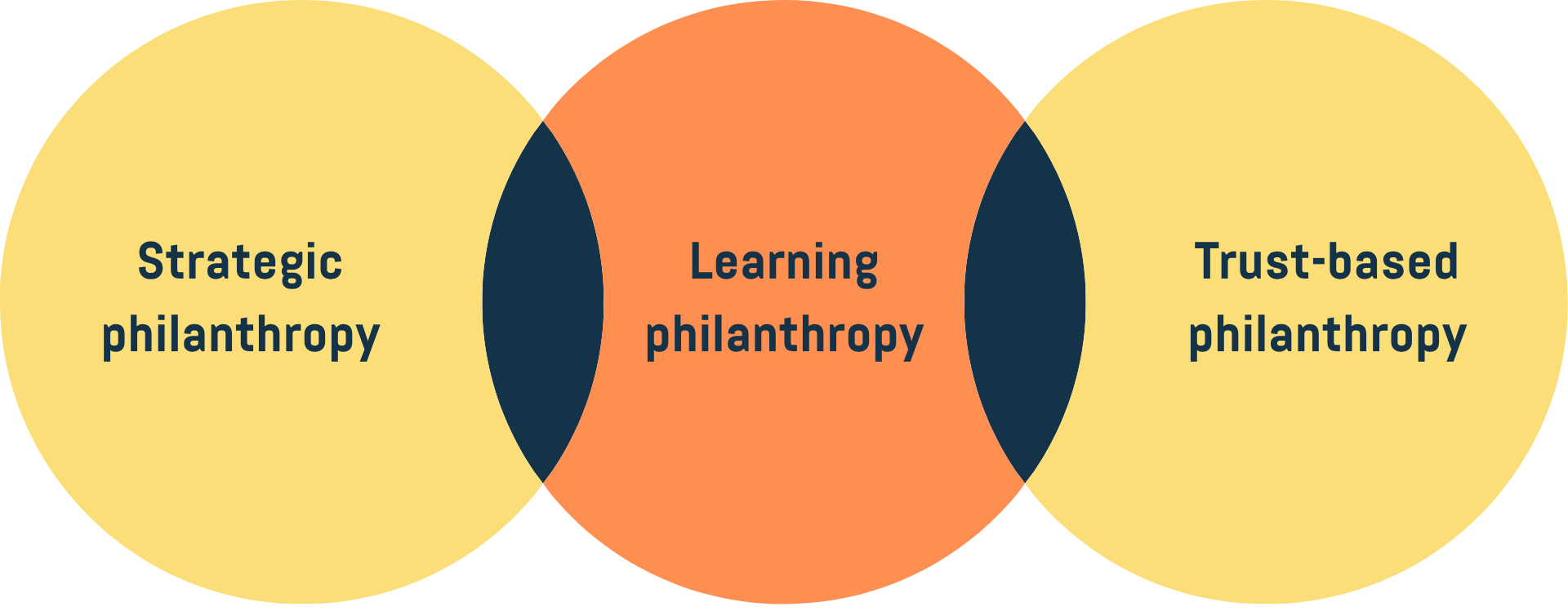
At Convive, we see learning philanthropy as a third way: an approach that connects strategic purpose with trusting relationships through a foundation’s ability to learn and act on what it learns.
This means building learning into how a foundation makes decisions, works with partners, leads its people, and contributes to the wider field. It gives strategy a way to evolve and trust a way to deepen through shared work.
What each approach brings—and what remains to be done
Strategic philanthropy brings a valuable insistence on purpose. It asks foundations to make choices, explain their assumptions, and assess whether their resources are contributing to change.
Its vulnerability is that a strategy can become harder to question once it has been approved. Evidence may be gathered to demonstrate progress while uncomfortable signals struggle to reach the people who could change direction. A foundation can have a sophisticated evaluation function and still find it difficult to learn.
Trust-based philanthropy brings attention to relationships, power, and the conditions partners need to do their best work. It challenges funders to reduce burdens, listen carefully, and recognize expertise beyond their own institution.
Those commitments are essential. But a commitment to trust still needs organizational practices that help a foundation interpret feedback, examine its own behavior, and follow through. An honest conversation only improves a funding relationship if the institution can respond to what it hears.
Both approaches therefore raise a further question: Does the foundation have the capability to change its thinking and practice?
That is where learning philanthropy begins.
Why learning needs to be intentional
Foundations operate in conditions where useful feedback can be difficult to obtain.
The effects of funding may take years to emerge. Social change rarely follows a predictable path. Partners may hesitate to challenge a funder. Staff may find it easier to defend an existing strategy than to reopen the assumptions behind it.
Under these conditions, valuing learning is a starting point. Making it happen requires deliberate work.
A learning philanthropy creates ways to surface different perspectives, make sense of experience, and use that understanding in decisions. It also preserves knowledge so that lessons can inform the next grant, the next strategy, and the next generation of staff.
This makes learning a practical capability for stewarding resources: helping a foundation make wiser choices under uncertainty, build relationships that carry more honest information, and accumulate understanding over time.
Learning across three connected areas
The Learning Philanthropy Framework describes three areas of learning practice: internal learning processes, learning with partners, and ecosystem learning.
Together, they expand the conversation beyond how a foundation manages its grants.
Internally, learning helps a foundation examine its own choices. Teams need opportunities to compare experience, challenge assumptions, and connect insights across programs and functions. Those insights need a route into decisions. Otherwise, a foundation can produce thoughtful reflections while continuing to operate much as it did before.
With partners, learning makes the relationship reciprocal. Partners bring knowledge of delivery, context, and lived experience. Funders may bring a wider view across investments, research, or connections. Learning together creates space to explore what each perspective reveals, where interpretations differ, and what to do next. The foundation’s practices belong in that conversation too.
Across the ecosystem, learning helps knowledge travel. A foundation’s experience can inform others working toward similar goals. It can also benefit from their discoveries, questions, and mistakes. Sharing what has been learned—including uncertainty and unresolved difficulties—helps the field build on experience rather than repeatedly starting over.
This is an important part of the third way. The focus extends from the individual grant relationship to the foundation’s capacity to learn within, between, and beyond those relationships.
Good intentions need the right conditions
Learning also depends on the environment in which people work.
The Framework identifies three accelerating conditions: learning leadership, learning culture, and structure and resources.
Their relevance is easy to recognize in everyday foundation life.
A program officer may receive candid feedback from a partner, but need leadership support to question an established funding approach. A team may identify a useful lesson, but need time and a process to apply it. Staff may be invited to discuss mistakes, but watch carefully to see what happens to the first person who does.
Leaders help learning take root when they ask open questions, acknowledge uncertainty, and show how new information changes their own thinking. Culture matters when people decide whether it is safe to disagree. Structures and resources matter when learning competes with everything else on the calendar.
These conditions make learning a shared responsibility across the institution. A learning lead can support that work, but cannot substitute for it.
Accountability that includes the foundation
Learning philanthropy also broadens accountability.
Partners should be able to explain their decisions and engage seriously with evidence. Foundations should be able to do the same.
What have we learned about our strategy? How has partner feedback affected our grantmaking? Which assumptions have we revised? What are we asking others to change, and what are we changing ourselves?
This is demanding work. It requires a foundation to examine the quality of its own decisions alongside the results of the work it funds.
It also makes accountability more useful. Information serves a clear purpose when it helps people decide whether to continue, adapt, or stop an approach. Reflection earns its place when it leads to action.
A third way worth practicing
Calling learning philanthropy a third way is a proposal for how strategy and trust can work together.
Strategy gives learning questions to pursue. Trust helps people share what those questions reveal. Learning provides the practices and conditions through which that understanding can shape action.
A foundation can therefore remain ambitious about change while being open about uncertainty. It can respect partners’ agency while contributing its own perspective. It can take evidence seriously while questioning how that evidence is interpreted and whose experience is missing.
For Convive, becoming a learning philanthropy means developing that capability across the entire organization.
A useful place to begin is with a question: When we learn something important, what happens next?
The answer reveals whether learning is an aspiration—or a practice that is helping us become more effective.