Written by: Heather Hutchings, The Convive Collective
At The Convive Collective, everything starts with the learner. We believe learning experiences are exponentially more effective when they are designed around how people actually prefer to receive, process, and apply information, rather than how we assume they should.
Learning isn’t just about content; it’s about context. Experiences are far more useful when they address real knowledge gaps and feel achievable within learners’ lived constraints of time, budget, and organizational culture. That’s why we always begin with a Learner Discovery before designing any learning experience with our clients.
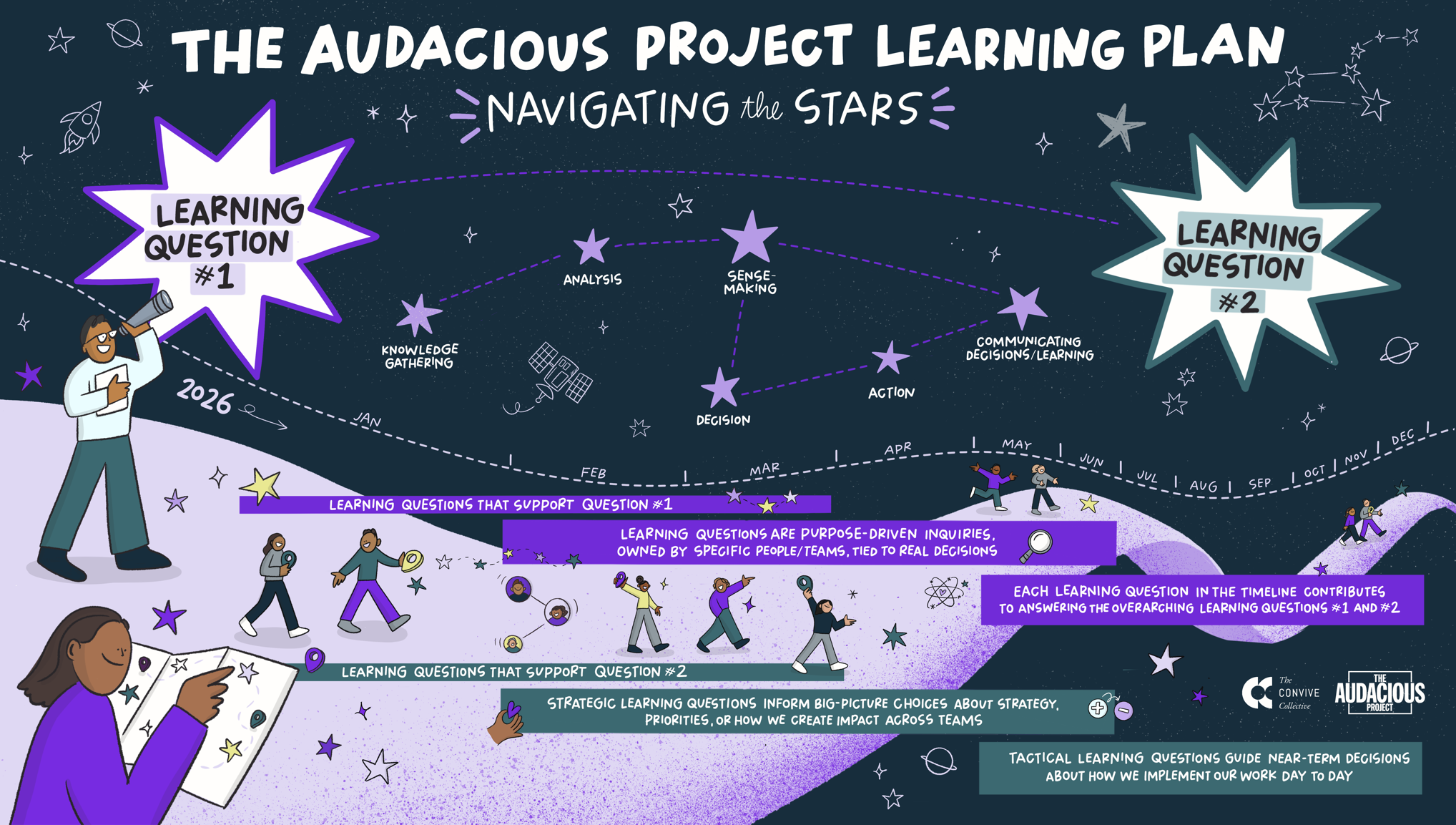
We recently had the pleasure of partnering with The Audacious Project to develop their annual learning plan starting with this discovery approach.
What exactly is a Learner Discovery?
A Learner Discovery helps us identify the unique "DNA" of a group of learners. We look at several key dimensions:
Interests and Knowledge Gaps: What specific information do they need to be more effective in their roles?
Preferred Approaches: How do they like to receive new information (e.g. reading, listening), process it (e.g. journaling, discussing), and apply it (e.g. immediate practice, sharing with others)?
Accessibility: Do the learners need, for example, captions to video, high-contrast visuals, extra time to process, or materials in advance?
Motivation and Orientation: Are they big-picture thinkers or detail-oriented? Do they crave theory or concrete examples? Are they enthusiastic or skeptical about learning?
Psychological Safety: How confident do they feel to exhibit learning behaviours like asking questions or admitting mistakes?
The Learning Environment: What are the organizational conditions—like budget and time for learning, systems for sharing knowledge, strategic clarity—that might support or constrain learning?
A Learner Discovery can be a survey, a series of focus groups, or one-on-one conversations—enough to give you a confident understanding of the groups’ needs and strengths; not so much to induce survey fatigue in the learners or analysis paralysis for the designers.
From Discovery to Design: The Audacious Project
With The Audacious Project, we started with a lean, 10-minute survey of just 14 questions. With a 90% completion rate, the team provided valuable insights that Convive then used to lead in-depth focus group discussions with team members. These sessions allowed us to pull on certain threads from the survey and hear, in the learners' own words, where their learning practices are thriving and where they are still nascent.
The discovery also revealed the highest-value learning topics or questions for the organisation – the answers to which would drive impactful decisions.
Designing a Plan That "Sticks"
The data we gathered from the survey and focus groups fed directly into The Audacious Project’s annual learning plan, shaping:
Learning Questions: areas of inquiry that inform data collection and sensemaking for 2026.
Learning Activities: tailored to match the team's known preferences for processing and applying new information.
Accelerating Conditions: recommendations to boost the organizational conditions for learning.
To ensure the learning plan truly resonated, we leaned, as we always do, into the "IKEA effect": the idea that people value things more when they help build them. We co-created the final plan in a three-day workshop with eight learning champions from Audacious. Their brilliance, combined with our facilitation, ensured the result was both practical and inspiring—as you can see!