Written by: Ashley Dresser, The Convive Collective
The work of philanthropy can often feel heavy. Funding decisions can influence an entire community. Power imbalances between funders and partners can undermine best intentions. And equity and justice considerations engage our deepest sense of morality. Over time, these dynamics can wear us down and stifle the curiosity and optimism that meaningful learning needs to thrive.
So if you’re a learning leader in your organization, what’s the antidote to this heaviness?
At Convive, we believe a little levity goes a long way! When you give people permission to laugh, play, and explore, you’re making space for agency and delight in the midst of the pressure to demonstrate impact.
Many of us already use humor to cope with current events, so leading with levity in our learning experiences can often feel like a natural fit. But it’s not just a feeling, cognitive science explains why it works.
Here are four ways that levity supports learning, plus two examples of how we at Convive have helped philanthropies apply these principles.
Levity reduces cognitive load.
Your working memory increases when you feel you’re in a low-stakes, friendly environment. Anchoring your learning experience with a playful metaphor, leading with a joke, or encouraging emoji feedback are just a few ways you can quickly signal this shift and invite people to have fun.
Levity sparks curiosity.
Just like your parents adding something new to your lunchbox gave you a sudden jolt of glee as a child, an unexpected approach to learning can sharpen your attention, improve memory encoding, and encourage deeper participation.
Levity promotes trust and adaptive thinking.
Humor in serious work implies trust. That trust is either already explicit or someone takes the risk of making light of something to see how it will land. Starting with intentional moments of levity into a learning conversation signals trust in your peers and invites them to relax their guard. People tend to reach an open and adaptive mindset more quickly, making room for a wider range of perspectives.
Levity broadens participation.
It’s difficult to look around the room in a philanthropy and not feel the nuances of hierarchy and expectations of expertise. These factors frequently influence who speaks and who holds back in a learning conversation. But when you establish having fun as a priority, the pressure to perform drops, and more people feel safe to share.
Here are two examples of the Convive Collective and our learning partners putting these principles into practice:
The “Lake of Learning”

What we did: For a climate philanthropy designing a quarterly learning loop, we introduced a nature-based metaphor called the “Lake of Learning”and invited participants to adopt different investigative roles such as First Light Paddler, Safety Kayaker, and Scout to guide the conversation.
Why it works: The metaphor moves people out of their usual organizational identities by assigning them new roles and the lake creates a calm, imaginative space to counteract a fast-paced work environment.
All in Favor, Say Emoji
What we did: In a sensemaking session where a climate philanthropy was revisiting the criteria they use to make decisions, we handed out printed emojis on popsicle sticks so people could hold them up in real time to show how they felt about different options.
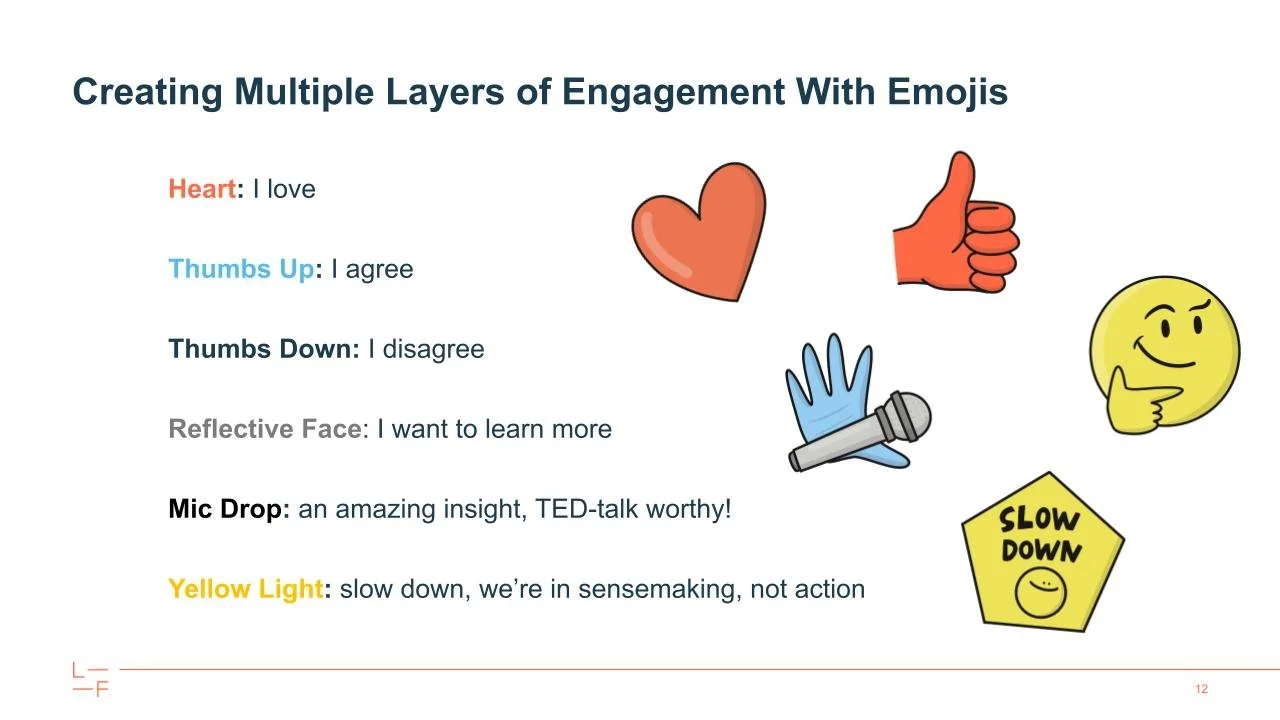
Why it worked: Bringing emojis into the room added a bit of novelty and play. No one expected to see emojis offline and on popsicle sticks. People had a simple, low-pressure way to react that was a bit like bidding at an auction. To our surprise, this mini-auction vibe even seemed to encourage people to speak up, as if they were playfully arguing over the price of something rare and worth winning.
The real weight of philanthropic work will always be there, but we feel lucky that we get to create learning spaces that offer moments of relief and openness. Time and again, we’ve seen how leading with levity supports richer thinking, stronger social and neural connections, and more honest participation. People show up more fully when they’re invited to have fun and until that changes, that’s exactly the intersection where you’ll find us.
Would you like to put more “fun” in funders’ work?
📬 Sign up for our newsletter below for updates, resources, and insights.
🎓 Join our Learning in Philanthropy Cohort—where we teach you how to bring the joy of learning to your organization with tools, templates, and a vibrant community of practice. To get on the waitlist, share your contact info with Ashley Dresser.
🤝 Ready to go further? Contact us to support your journey to becoming a more effective learning philanthropy.