Written by: Katherine Haugh, The Convive Collective
Evidence Days began with Lee Risby at the Laudes Foundation, who realized that the traditional boardroom setting is abysmal for learning (or “rubbish” to use Lee’s phrasing).
And Lee is right to challenge it: the neuroscience of learning (our absolute favorite topic at Convive) gives us good reason to rethink a room where everyone sits politely, passively receiving one-way presentations.
Lee had a different idea: let’s borrow the concept of a science fair and get everyone up and moving around, discussing and debating the evidence. He took a risk in leading Laudes through their first Evidence Day with staff, leadership and their Board in 2023. And it worked. It’s become an annual event for Laudes since then.
According to the neuroscience of learning, Evidence Days work because they bring together so much of what helps us learn: clear visuals that make information easier to grasp, questions that connect new evidence to what we already know, and conversation that pushes us to explain, reflect, and make meaning together. Add movement and the freedom to follow our curiosity, and you’ve created an experience that invites people to learn in the best way possible.
Since our time supporting Laudes in bringing their first Evidence Day to life, we’ve supported countless foundations in leading similar Evidence (or Learning!) Days. And it’s crazy – they always work.
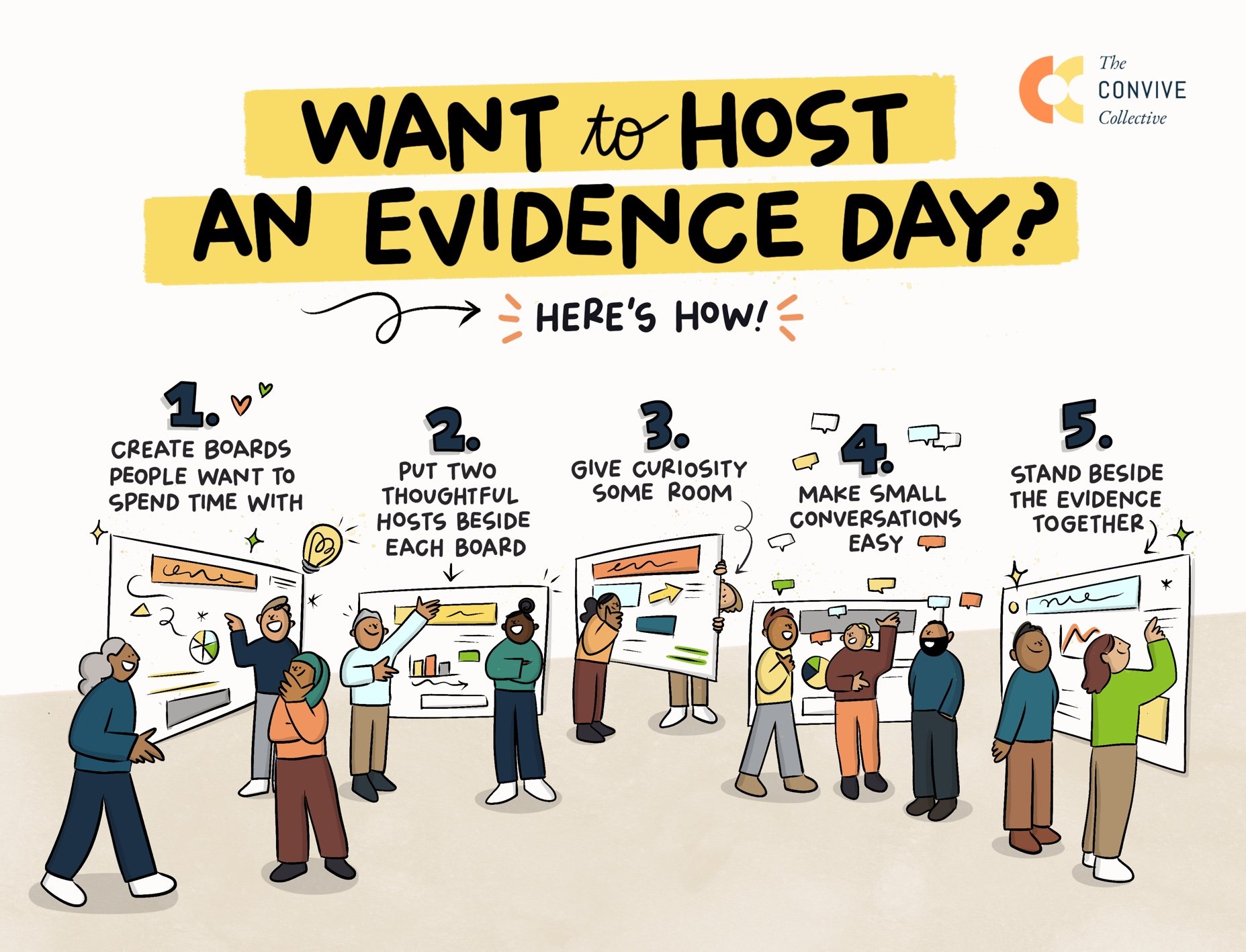
Want to host your own? Here are our five tips:
Make your evidence boards beautiful—and meaningful. Your Evidence Boards need to have: quantitative data, qualitative data told in story form), and honest reflections and learning. You want them to enjoy taking in the information. Design deserves real attention.
Give each board a hosting duo. Pair a program head with an impact lead to offer a brief overview of the Board and invite questions. People can’t and won’t learn from reading the Board alone. A favorite trick: ask each host to share their favorite part of the board and why. That personal touch brings the evidence to life.
Let curiosity set the agenda. Give learners permission to follow what interests them. “I want to understand this context data.” “Tell me more about this intelligent failure.” Leave enough room for those questions to shape the conversation. Don’t tell them where to go or what to ask.
Keep people moving and groups small. Let participants circulate freely, linger, and join different conversations. Small groups can make it easier to ask a tentative question, challenge an assumption, or admit that something doesn’t make sense yet.
Find the magic in standing shoulder to shoulder. There’s something powerful about an impact lead and a Board member looking at the evidence together. Both can point, question, and explore. Resist the habit of turning a beautiful evidence board into another slide deck.
Friends, your team has worked hard to generate the evidence. Give people the space—and the invitation—to learn from it.