Written by: Katherine Haugh, The Convive Collective
One question keeps coming up in my conversations with foundations:
What's the difference between Learning & Development and Organizational Learning—and why does it matter?
At first glance, they can seem like two sides of the same coin. Both are concerned with learning. Both help organizations grow. Both often involve the same people.
But the more I sat with the question, the more I realized that many organizations are wrestling with where one begins and the other ends.
[TLDR: Org learning and L&D were definitely the power duo that Jack Johnson was singing about in his song, “Better Together.”]
That's what inspired the framework below.
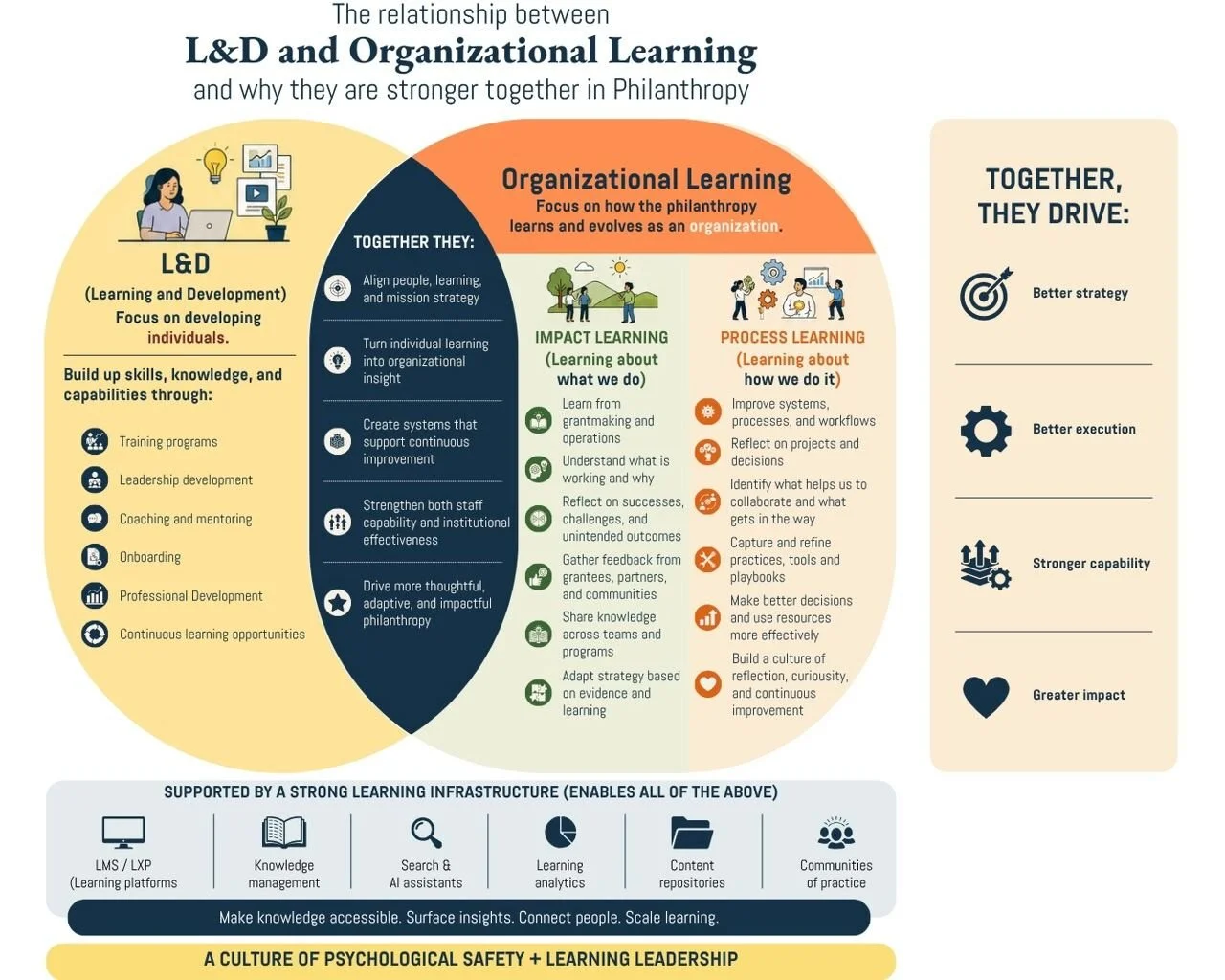
At its simplest:
Learning & Development builds the capability of individuals.
Organizational Learning builds the capability of the organization.
Together, they help philanthropy learn, adapt, and improve.
The response to this visual on LinkedIn caught me by surprise.
What started as an attempt to clarify a distinction I was seeing in my work quickly sparked conversations with learning leaders across philanthropy.
It seemed to resonate because it gave language to something many of us have been grappling with:
How do we build the learning capacity of both people and institutions?
And what happens when those two forms of learning become disconnected?
Not because philanthropy lacks commitment to learning.
But because learning often lives in different places, under different teams, with different goals and responsibilities.
The most adaptive organizations don't choose between Learning & Development and Organizational Learning.
They invest in both—and deliberately connect them.
What Can Philanthropy Borrow from the Private Sector?
In search of answers, I looked beyond philanthropy.
What I've noticed is that many private-sector organizations are remarkably intentional about connecting Learning & Development and Organizational Learning. They don't tend to treat them as separate conversations.
Instead, they create systems where individual growth fuels organizational learning—and organizational learning shapes individual growth.
In other words, they get the high-five right.
To explore this idea further, we brought together learning leaders from Patagonia, Mentimeter, and Airbnb for a closed-door Learning Circle conversation. What struck me wasn't that these organizations had bigger learning teams, larger budgets, or more sophisticated tools. Quite the opposite. Several had smaller teams and fewer resources than many philanthropic organizations.
The practices themselves varied, but each one was designed to strengthen the connection between individual learning and organizational learning.
Three approaches stood out.
1. Create Connection, Not Just Content
The strongest learning cultures aren't built on training libraries or endless resources.
They're built on opportunities for people to make meaning together.
Our guests described creating spaces where employees can explore emerging questions, share perspectives, and collectively interpret what matters.
One example that stuck with me came from Mentimeter. Their annual Learning Quest brings employees together for a gamified learning experience that invites teams to learn alongside one another rather than in isolation.
Chef's kiss for learning experience design.
For philanthropy, that's a useful reminder: Most people don't need help being curious.
They need time, space, and thoughtful invitations to explore that curiosity together.
2. Connect Personal Learning Goals to Organizational Priorities
Many organizations are good at helping employees identify professional development goals.
Far fewer are intentional about connecting those goals to what the organization itself is trying to learn.
One organization shared how they approach learning through a curriculum model. Rather than treating professional development as a collection of individual learning activities, they create learning pathways that connect employee growth with organizational priorities.
This creates a powerful feedback loop.
Employees can see how their learning contributes to broader organizational goals, while organizations gain new capabilities and insights through the growth of their people.
The result is that Learning & Development doesn't sit beside Organizational Learning—it actively fuels it.
3. Build a Network of Learning Champions
One of the most interesting examples came from Patagonia.
Rather than relying solely on a centralized learning function, they have invested in a network of learning champions across the organization.
These champions help facilitate conversations, surface emerging insights, encourage reflection, and connect learning across teams.
What I love about this approach is that it recognizes learning as a collective responsibility.
It also acknowledges a reality many philanthropic organizations face: there may never be a large learning team.
A distributed network of champions can help learning travel further, faster, and more sustainably than a single team ever could on its own.
And if you're a team of one—or don't have a dedicated learning function at all—a learning champion network might be one of the highest-leverage places to start.