
Written by: Katherine Haugh, The Convive Collective
A huge thank you to Tanya Beer & Jewlya Lynn for their thought leadership and content presented in this visual and to the team at CEI for hosting the learning series! Go here for their must-watch session recordings.
AI is like… because …
Alexandria: a golden retriever: eager to please, and without proper training, you’ll spend more time cleaning up its messes than playing fetch.
Heather: a hammer mistaken for a multi-tool: people think it can fix everything, but are we even sure of the nail?
Monalisa: a wearable neck fan: flashy, fun, and kind of useful, but not completely necessary.
Kat: unreliable, unhinged devil on your shoulder: feeding you nonsense, but also sometimes it sounds fun
Much of the discussion about AI and impact assessment in philanthropy focuses on how we can use the technology to get answers more quickly. But what if one of AI’s most valuable uses is helping us slow down, question our assumptions, and think through difficult evaluative judgments?
That question stayed with us after AI Macroscope’s learning series. AI can help draft an email or turn notes into slides. But the possibility we kept coming back to was what happens when we ask it to complicate an answer we were ready to accept. What evidence would change our minds? Whose experience might tell a different story? But to get there, we need to start by using AI responsibly.
Questions & guardrails to guide responsible AI use
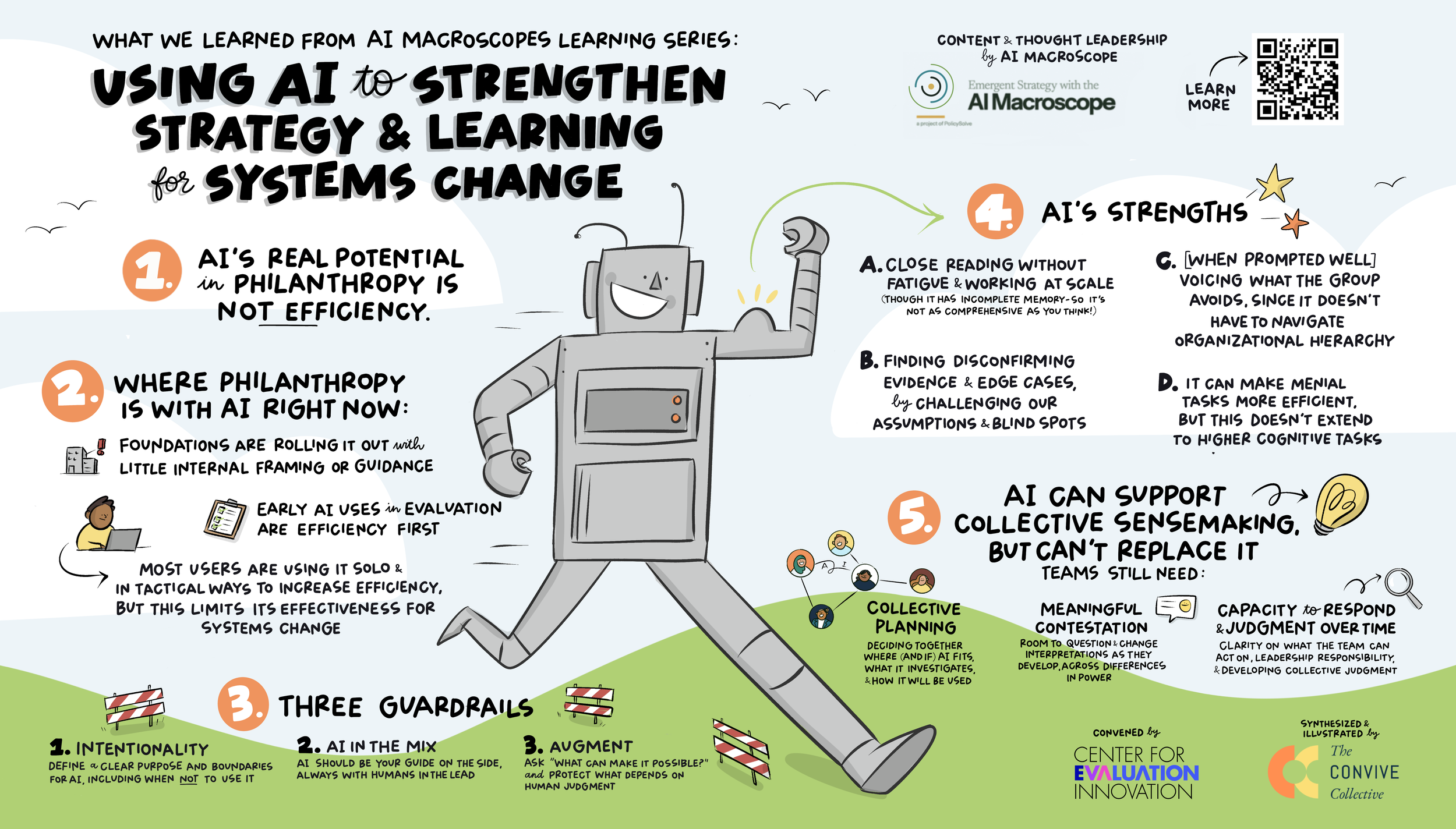
One concern raised in the series was that many foundations are adopting AI before establishing internal framing or guidance on how to use it. Beyond the how, there are other key questions that remain unanswered:
When is AI used?
Who decides?
And what happens with its outputs?
And critically, is this clear and understood across the organization?
AI’s early applications in evaluation often focus on speed, and much of that work happens individually. More broadly, much of AI use in philanthropy is a solo effort focused on individual tasks and projects. And while a faster first draft can be helpful, it can also make it easier to skip the conversation where a colleague would have questioned the framing or a partner would have offered a different interpretation. When individual use for efficiency becomes the default, AI’s potential to strengthen systems change work is limited and could even be counterproductive.
The series offered three guardrails that help shift AI from a tactical, individual tool to a strategic, collaborative one:
Intentionality: Define a specific purpose and the boundaries of AI’s role, including when not to use it. Importantly, never use it to replace voices that we often fail to listen to: communities, vulnerable populations, and partners.
AI in the mix: Keep humans in the lead, with AI in a supporting role. People decide what matters and how to act. And share your ingredients (prompts, sources, and how you used the outputs) so AI is used transparently, collaboratively, and ethically, and no partner is surprised it’s there.
Augment: Ask what AI could help you investigate, consider, or discuss that would otherwise be difficult, not just what it can do faster. And protect time for the conversations that draw on human judgment, relationships, values, and lived experience.
What AI does well and where it struggles
With the right structure, it can read closely without tiring and work through more material than most people have time for. It can go back to the data again and again, and bring in frameworks or expertise a team might not have on hand. And with proper prompting, it can also look for evidence that challenges a consensus, test edge cases, and help surface concerns that people may hesitate to raise when power dynamics make it hard to speak up.
It also has real limits. When in conversation with AI, it doesn’t hold onto everything. With a large amount of text, it will quietly decide what to keep and what to drop, without telling you what it skipped. It can fill gaps with claims that sound right but aren’t, or neat cause-and-effect stories the evidence doesn’t support, all in a polished and confident presentation. Most AI platforms will have a disclaimer akin to “AI can make mistakes, be sure to double-check” but as Jewlya put it, “we’re used to failure looking like failure.” We don’t always get the obvious cue that something is awry like we would with an Excel formula or a red spell-check squiggle.
AI also carries two types of bias at once: what it absorbs in training (representational) and what it absorbs from the user (conversational). And because AI is designed to keep us engaged on the platform and please us, it can reinforce these biases rather than surface them. Even models that pass explicit bias tests still show implicit bias, like associating men with science and women with the humanities. And these associations reflect deeper structural bias: long-standing patterns in who holds power, whose knowledge counts, and whose stories get recorded. After all, AI learns from information humans produce and share, so the biases and structures we’ve built show up in it, too.
Collective sensemaking stays human
AI can help organize the evidence and bring plausible interpretations into view. But it cannot replace collective sensemaking. Teams still need collective planning, deciding together where (and if) AI fits, what it investigates, and how its outputs will be used. It requires meaningful contestation, with room to question and change interpretations as they develop, across differences in power. As the series put it, people’s contributions need to be able to change the analysis. And it takes capacity to respond and exercise judgement over time, as people decide how to respond, take responsibility for those decisions, and revisit them as they learn more.
Why does the collective part matter? When a team shapes something together, they build a shared mental model of the system and the strategy. That sharpens everyone’s judgment and fosters the buy-in a strategy needs to actually be implemented. AI can help push beyond the foundation’s familiar framing and into questions no one person would have thought to ask, but it is people, together, who decide which questions matter and what to do with the answers. Through a collective process, insights become shared knowledge that partners can question and build on, not something quietly held by a few. And when a well-loved strategy doesn’t hold up, a team that has done this work together is better equipped to face that and adapt.
Seven ways to use AI to strengthen your strategy & learning work
The Premortem Strategist. Your AI imagines your strategy has failed and diagnoses why, using a structured set of prompts. Then discuss which risks deserve attention. A good premortem may add work by surfacing an assumption you need to test before moving ahead.
The Devil’s Advocates. Prompts that make your AI respond as a critical friend, helpful partner, or bold naysayer. Each identifies evidence that could challenge your interpretation and suggest questions for the team to discuss.
The Bias Interrogators. Use a simulated perspective to anticipate objections from a financial or political decision-maker you rarely hear from or don’t have access to. Treat those objections as hypotheses and make space for communities to speak for themselves.
Tree of Thought. When AI settles on one answer too quickly, ask for several plausible explanations or courses of action and what evidence would help you choose among them.
Analytical Frameworks. When an answer feels generic, ask AI to examine the issue through a named lens, such as Adaptive Leadership. Discuss what the framework helps you see and what it leaves out.
Perspective Taking. Ask which perspectives are reflected in group conversations and whose might be missing. Look for recurring patterns yourself and use them to decide whom to hear from next.
Quality Control. Always have AI audit its own answer for weak evidence, bias & framing, then rewrite (because AI failures can be missed under the polish).
We have already experimented with several of these internally and with our clients, and continue to learn what actually expands our thinking and improves the quality of our work.